
Background
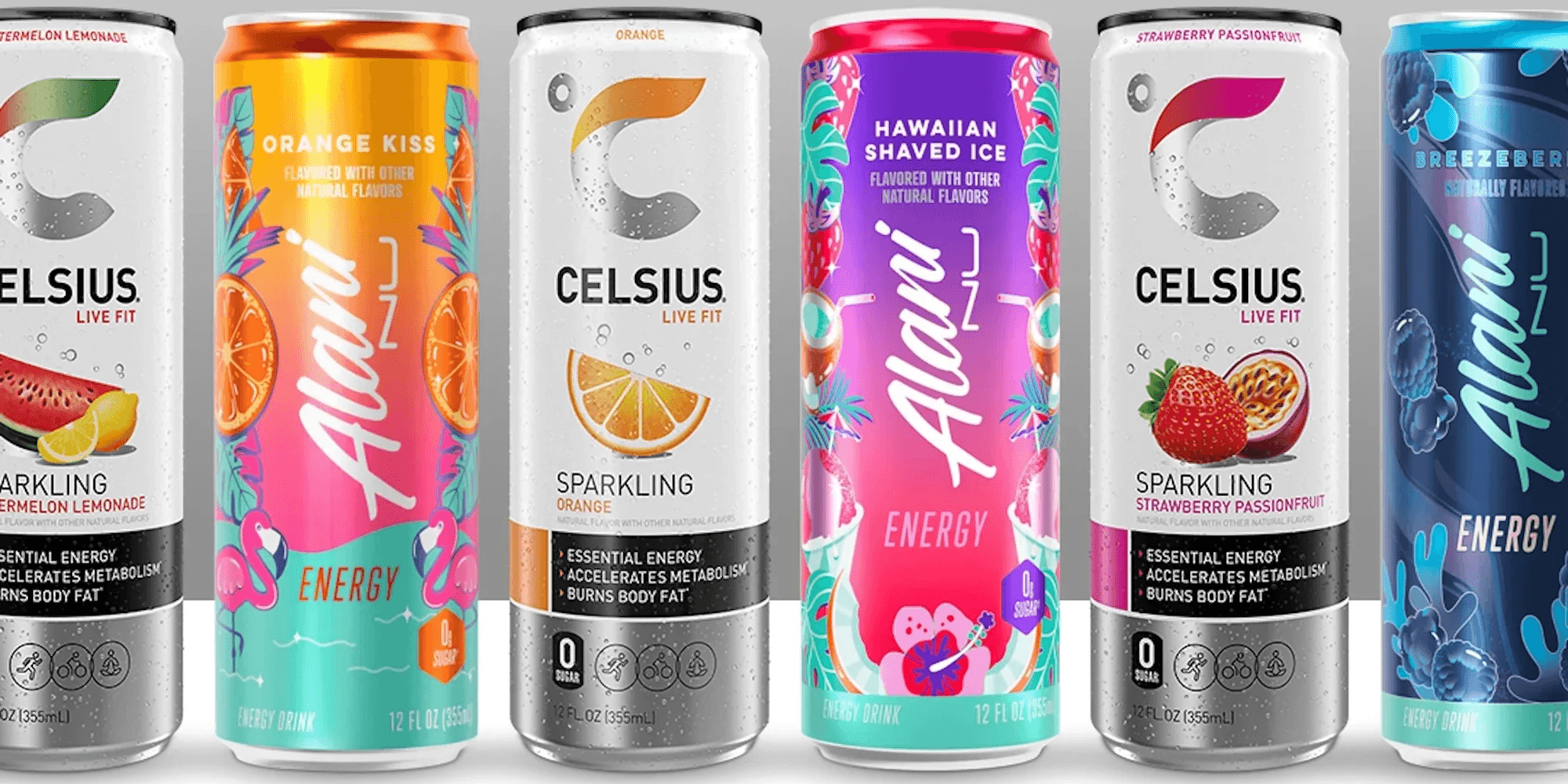
Celsius Holdings was founded in 2004 and trades on the Nasdaq under the ticker CELH. For most of its history, the company was a small-cap specialty beverage brand without meaningful national distribution. That changed in 2022, when PepsiCo took an equity stake and became Celsius's exclusive U.S. distributor. Today, Celsius operates a portfolio of three energy drink brands: its namesake CELSIUS line, Alani Nu (acquired April 2025), and Rockstar Energy (consolidated under Celsius as part of an expanded August 2025 agreement with PepsiCo).
The company reported $2.52 billion in revenue for FY2025, trades at an enterprise value of roughly $8.9 billion at the May 11 publish price of $29.50 on 255M diluted shares, and holds approximately 20% dollar share of the U.S. energy drink category per Nielsen scanner data. The CELSIUS brand alone held roughly 5% three years earlier, before the Alani Nu acquisition and Rockstar consolidation lifted the combined portfolio to current levels. Celsius is now the third-largest energy drink brand in the U.S. by dollar share, behind Red Bull and Monster. The U.S. energy drink category has been growing at a mid-single-digit rate, with functional and zero-sugar sub-segments growing faster, both of which are areas where Celsius's product mix is concentrated.
U.S. Energy Drink Dollar Share by Brand
The Alani Nu Acquisition
On April 1, 2025, Celsius closed its acquisition of Alani Nu, a women-focused energy and wellness brand. Alani Nu had been one of the faster-growing brands in the U.S. energy category, with a customer base that skewed female, a demographic underrepresented in the legacy CELSIUS mix.
The acquisition does three things. It expands Celsius's addressable market into a segment where the namesake brand was underweight. It removes Alani Nu as an independent competitor in convenience and grocery channels. And it consolidates manufacturing, distribution, and retailer negotiation across both brands. FY2025 revenue grew 86% year over year. Most of that headline growth came from the Alani Nu acquisition and Rockstar consolidation, while the legacy CELSIUS brand itself grew in the high single digits organically.
Rockstar and the PepsiCo Partnership
The PepsiCo partnership was signed in August 2022, when PEP took a minority equity stake and became Celsius's exclusive U.S. distributor. That agreement gave Celsius access to PepsiCo's Direct-Store-Delivery network and unlocked national convenience and gas-station placement, the most important channel for energy drinks.
In August 2025, that agreement was amended. As part of the broader transaction surrounding Alani Nu, Celsius assumed control of the Rockstar Energy brand from PepsiCo's portfolio. Rockstar adds a value-tier offering, complementing CELSIUS at the premium end and Alani Nu in the female wellness segment. The combined portfolio now spans three price points and three consumer segments under one operator. For PepsiCo, the restructuring concentrates its energy-drink strategy on a single partner.
PepsiCo's economic stake sits in two tranches of convertible preferred stock: the original Series A from August 2022 ($550M) and the Series B added in August 2025 ($585M) alongside the Rockstar consolidation, both paying 5% cumulative dividends. The structure aligns PepsiCo's incentives with common holders (distribution performance flows back through dividends and conversion economics), but it caps the upside common shareholders capture if Celsius's market price ever rises far enough to trigger preferred conversion.
International Expansion
International is still small in absolute terms but is the fastest-growing piece of the business. FY2025 international revenue reached $92.8 million, up 24% year over year, or roughly 3.7% of total revenue. The Nordics remain the established core, with the UK, Ireland, France, Australia, New Zealand, and Benelux contributing the bulk of incremental growth. Q1 2026 international revenue accelerated to $35.3 million, a 55% year-over-year increase, with Spain newly launched through a partnership with Suntory Beverage & Food and Portugal slated as the next European market.
Management has framed international as a multi-year build, identifying ten priority markets beyond the U.S. Internal addressable-market work pegs the U.S. at roughly $28.5B, the UK at $2.79B, Australia at $2.06B, and France at $945M, with the combined non-U.S. priority list adding approximately $8B of incremental opportunity. A new global headquarters in Dublin was established in 2025 to coordinate the international rollout. The strategy is deliberate rather than aggressive, focused on building distribution depth in each market before adding the next, which limits near-term margin contribution but reduces the risk of expensive launch-and-retreat cycles that have historically plagued U.S. beverage brands going abroad.
Financial Snapshot
FY2025 results are distorted by acquisition accounting and integration costs. The underlying figures:
- Revenue: $2.52 billion, up 86% year over year
- Adjusted EBITDA: $620 million, a 24.6% margin
- Free cash flow: $323 million
- Total debt of $670M against $399M cash, leaving net debt of $271M
Celsius Holdings Revenue ($B)
GAAP net income of $108M, or diluted EPS of $0.25, understates underlying earnings power because acquisition-related expenses, deal fees, and inventory step-ups flowed through the income statement in FY2025. EBITDA and free cash flow are more representative of operating reality.
Celsius Holdings Free Cash Flow ($M)
Recent quarterly trends are constructive. The Alani Nu deal closed on April 1, 2025, so FY2025 reflects only nine months of contribution from the brand, and Rockstar was consolidated on August 28, 2025, so Q4 was the first full quarter of the combined three-brand portfolio. Q4 showed sequential improvement in gross margin as one-time integration costs began rolling off. Management has indicated that cost-synergy realization, SKU rationalization across the Rockstar legacy lineup, and continued international rollout will be the primary operational priorities in FY2026.
For FY2026, management has guided to high-single-digit organic growth at the legacy CELSIUS brand, with reported revenue further boosted by the first full year of Alani Nu and Rockstar contribution. Consensus revenue estimates currently sit in the $3.4 to $3.5 billion range, implying roughly 35 to 39% reported growth, which aligns with the assumption embedded in my DCF. Management has also reiterated its medium-term EBITDA-margin target in the high-20s, contingent on integration completing on schedule.
Q1 2026 results, reported May 7, support that growth path: revenue of $782.6 million (up 138% year over year) marked the first full quarter of the three-brand portfolio under one P&L, and international momentum continued with $35.3M of segment revenue (up 55% year over year). Adjusted EBITDA of $195M translated to a 24.9% margin, an expansion of roughly 370 basis points versus the 21.2% Q1 2025 prior-year period. Gross margin compressed from 52.3% to 48.3%, reflecting the lower-margin mix of the acquired Alani Nu and Rockstar brands, but operating leverage from roughly $50M of Alani Nu integration synergies more than offset the headline gross-margin step-down. The print did not change the FY2026 consensus range and keeps the path toward the 27% medium-term EBITDA-margin target intact.
Celsius's debt-to-equity ratio of 0.23 is well below the 1.26 peer median (Monster, Coca-Cola, PepsiCo, Keurig Dr Pepper), and its current ratio of 1.68 compares favorably to a peer set with mixed liquidity profiles: Monster runs a cash-rich 3.4, Coca-Cola sits near 1.0, while PepsiCo (0.8) and Keurig Dr Pepper (0.6) operate below 1.0 by design given their working-capital structures. The balance sheet supports additional M&A, marketing investment, or international expansion without meaningful incremental leverage.
Profitability
Celsius's FY2024 operating margin of 11.5% sits below peers like Monster (25.8%) and Coca-Cola (28.7%). FY2025 GAAP operating margin compressed further to roughly 5.6% on $327M of distributor termination charges and $60M of acquisition costs tied to Alani Nu and Rockstar. Part of the underlying gap is structural, since Celsius lacks the scale and in-house concentrate manufacturing that support peer margins, and part is transitional, reflecting acquisition costs, integration spend, and Rockstar's lower current margin profile.
The DCF assumes EBITDA margins expand from 24.6% in FY2025 to 27% by 2028 and hold there. That would still leave Celsius below Monster's 28.5% but above the broader peer average.
Operating Margin: Celsius vs. Beverage Peers
A Cheap Multiple as the Setup
Before walking through the DCF, the multiple is worth pausing on. At an $8.9B enterprise value (inclusive of $1.14B of PepsiCo preferred at liquidation value) and $620M FY2025 Adjusted EBITDA, Celsius trades at roughly 14.4x EV/EBITDA, against a peer-set median (Monster, Coca-Cola, PepsiCo, Keurig Dr Pepper) near 19x. The discount reflects market skepticism on integration execution and acquisition-cost overhang, both of which the FY2025 print and Q1 2026 update materially de-risk. A re-rate even halfway back toward the peer median produces meaningful upside before any FCF growth is layered on, and frames why the DCF below converges on a fair value well above today's price even at conservative discount-rate assumptions.
DCF Valuation
The DCF uses a five-year explicit forecast. Key assumptions:
- Revenue growth: tapers from 37% in FY2026 (the consensus mid-point, reflecting the first full year of Alani Nu and Rockstar contribution layered on high-single-digit organic growth at legacy CELSIUS) to 7% in FY2030.
- EBITDA margin: expands gradually from 24.6% in FY2025 to 27% by FY2028 and holds.
- Capex: 1.5% of revenue, slightly above the 1.4% four-year historical average to leave room for ongoing Big Beverages vertical-integration spend.
- Net working capital: 15% of incremental revenue, below the 18% to 34% range Celsius has shown in its two clean growth years, on the view that receivables intensity normalizes once the PepsiCo distribution ramp stabilizes and Alani Nu fully laps.
- WACC: 9%, reflecting the company's low leverage and high incremental margins, partially offset by single-distributor concentration risk.
- Terminal growth: 3%, in line with long-run U.S. nominal GDP growth and the high end of large-cap beverage peer terminal assumptions, reflecting the still-expanding global energy drink category.
The model produces a sum of PV of explicit FCFs of roughly $2.9B and a PV of terminal value near $10.9B, for an enterprise value of approximately $13.8B. After adjusting for net debt, equity value works out to roughly $49 per share on 255M diluted shares (a 66% premium to the May 11 publish price of $29.50).
| Methodology | Implied Price | Upside |
|---|---|---|
| DCF (base case) | $49 | +66% |
| Peer EV/EBITDA (median 19.1x) | $41 | +39% |
| Peer P/FCF (median 29.9x) | $33 | +12% |
| Blended (50% DCF / 50% multiples) | $43 | +46% |
DCF runs meaningfully ahead of the peer multiples because the multiples apply mature-beverage-peer trading levels to Celsius's FY2025 metrics and do not credit the next three years of growth. EV/EBITDA and P/FCF are still useful as anchors, but for a name in the middle of step-function growth from M&A integration and international rollout, intrinsic valuation should lead.
The sensitivity table shows the implied share price across a range of WACC and terminal-growth assumptions. Even at 11% WACC and 2% terminal growth, the model still implies a price slightly above today's level.
| WACC ↓ / g → | 2.0% | 2.5% | 3.0% | 3.5% | 4.0% |
|---|---|---|---|---|---|
| 9.0% | $42 | $45 | $49 | $53 | $58 |
| 9.5% | $39 | $41 | $44 | $48 | $52 |
| 10.0% | $36 | $38 | $41 | $44 | $47 |
| 10.5% | $33 | $35 | $37 | $40 | $43 |
| 11.0% | $31 | $33 | $35 | $37 | $39 |
Risks
- Integration execution: Integrating Alani Nu and Rockstar simultaneously carries operational risk. Slippage on cost synergies or unexpected cannibalization between brands would compress the margin recovery.
- PepsiCo dependence and contractual optionality: A single distribution partner handles substantially all of Celsius's U.S. volume. The original 2022 agreement and the amended 2025 agreement contain termination, change-of-control, and performance provisions that, if triggered, could force renegotiation or transition to an alternative distributor at material cost.
- FX and international rollout: Expansion into the UK, Ireland, France, Australia, New Zealand, Benelux, and now Spain introduces foreign-currency exposure on revenue and unhedged operating costs. A stronger U.S. dollar would compress reported international growth and margin contribution, and the deliberate market-by-market rollout means international scale benefits arrive slowly.
- Regulatory risk: Energy drinks face periodic scrutiny over caffeine content and marketing to younger consumers. New labeling or age-related restrictions could weigh on category growth.
- Competition: Ghost, C4, Bang, and other functional brands continue to compete for shelf space and consumer attention.
- Margin recovery and multiple re-rating: The thesis depends on operating margins expanding as acquisition charges roll off and the multiple re-rating toward the higher end of the peer range. If margins fail to recover, the multiple could compress further toward 12 to 13x and the share price would likely fall even as EBITDA grows.
Conclusion
Celsius now operates a three-brand portfolio with roughly 20% U.S. energy drink share, distributed by PepsiCo, growing off a higher base than at any prior point in its history. FY2025 GAAP results understate underlying earnings because of acquisition-related expenses, and Q1 2026 already shows the three-brand portfolio operating cleanly under one P&L. The setup is a 14.4x EV/EBITDA stock against a peer set near 19x, with a credible path to margin expansion as integration costs roll off. The DCF implies $49 per share at a 9% WACC and 3% terminal growth (a 66% premium to the May 11 publish price of $29.50), and peer-multiple cross-checks anchor a wider range from $33 to $41. I rate Celsius Holdings a Buy with a $49 price target and will track margin progression alongside Alani Nu and Rockstar integration.

Equity Researcher · CFA Research Challenge Champion
Independent equity researcher focused on fundamental analysis and long-term value creation. Data-driven, fundamental-first.